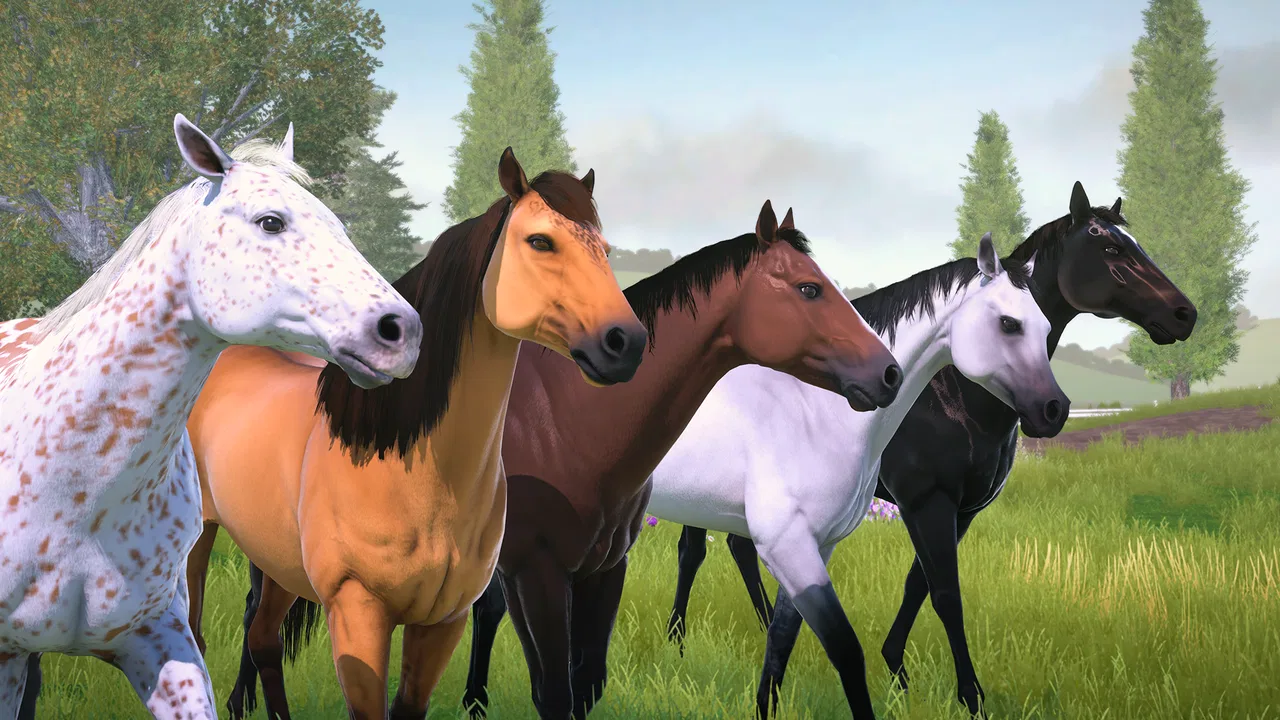
Rival Stars Horse Racing
- 4.4
- Rating
- 10.00M
- Installs
- Free
- Price

 Analysis by App-foxy
I spent time with Rival Stars Horse Racing as a mobile sports game, and my first impression was that it is less about quick arcade races than about building a relationship with a stable over time. You breed horses, train them, prepare them for competition, and make decisions about how to develop your operation. That combination gives the game a more personal rhythm than a straightforward racing title.
It is free to start, rated for Everyone, and developed by PIKPOK. The game has been available since April 23, 2019, and its current version is 1.69.1. Those details matter because this is an established mobile game rather than a brand-new experiment, with a substantial player base behind it. The store shows a 4.4 average from roughly 279,000 ratings, alongside more than 10 million installs.
My honest recommendation is fairly specific: try it if you enjoy gradual progress, horse management, and races where preparation matters. If you want an instant, purely skill-based racing game with no stable chores or long-term upgrades, this probably will not be your best match. The appeal comes from the loop between caring for horses and taking them back onto the track.
You May Also Like

 Google Keep - Notes and lists
Google Keep’s Quiet Growth Shows the Appeal of Simpler Notes
As mobile work gets busier, Google Keep keeps winning a simple contest: capture a thought quickly, find it later, and get on with the day.

 Blood Strike: 2.5 Anniversary
Blood Strike’s Loadouts Turn Every Drop Into a Tactical Gamble
A close look at Blood Strike’s custom loadouts: how fast access to signature weapons reshapes its battle royale rhythm, rewards preparation, and narrows the gap between fights.

 Pandora - Music & Podcasts
Pandora’s Music Is Easy to Start, but Harder to Recover
Pandora’s strength is its low-effort path from a seed to a station. Its weak spot is how much confidence it asks you to place in connection, setup, and quiet recovery.

 8 Ball Pool
 Is Built on Rivalries, Rematches, and Routine
A close look at the rivalries, rematches, shared routines, and unanswered safety questions that turn a quick pool match into a persistent mobile community.

 Samsung Music
’s Quiet Strength Is Playing What You Already Own
Its reach comes less from spectacle than from dependable access to a personal library. That simplicity is both the app’s strongest retention engine and its ceiling.

 AccuWeather: Weather Radar
AccuWeather Review: A Quick, Clear Forecast for Everyday Decisions
For everyday plans, the best forecast is the one you can understand quickly. AccuWeather makes rain timing, radar, and local conditions easy to act on, with a few trade-offs.
More From Our News Desk



How the stable-and-racing loop feels in everyday play
The main attraction is the way individual activities connect. A race is not an isolated event; it sits inside a larger routine involving the horses in your stable. You are encouraged to think about which horse is ready, what kind of training makes sense, and when it is worth spending time on development instead of immediately entering another event.
I found that structure especially comfortable for short sessions. For example, I could open the game during a commute, check the stable, handle a training task, and leave without feeling that I had abandoned a complicated strategy plan. Later, when I had more time, I could return for a race and make better use of the preparation I had already done. That makes it easier to fit into an ordinary day than a game that demands one long uninterrupted session.
The racing itself works best when treated as the visible result of your stable decisions. New players may initially focus on crossing the finish line, but the more useful question is why a horse performed well or poorly. Was it properly trained? Was the chosen horse suitable for the challenge? Did I rush it into competition before it was ready? Thinking this way gives the game more depth than simply tapping through races.
There is also a satisfying sense of ownership in watching a horse develop. Even when progress is incremental, the stable gives your decisions a lasting context. A horse is not just a temporary vehicle for collecting a reward; it becomes part of the way you understand your roster. That is one of the strongest reasons I would recommend the game to someone who likes management elements in sports games.
Breeding is more than a decorative side activity
Breeding adds a planning layer that changes how I view the stable. Instead of treating every horse as disposable, I started thinking about the value of keeping a promising line and choosing carefully when to expand or adjust the roster. This is a useful distinction from many mobile racing games, where new vehicles are simply stronger replacements.
The practical tip here is to avoid treating every new horse as an automatic upgrade. A larger stable can sound appealing, but more choices are only useful when you understand what each horse contributes. I found it better to pay attention to how a horse fits my current progression rather than chasing novelty. That approach reduces clutter and makes later decisions easier.
Breeding also gives the game a slower pace than a conventional racing app. Players who enjoy seeing long-term results from small choices will appreciate that. Players who dislike waiting, repeated preparation, or maintaining a roster may experience the same system as friction. The game asks for patience, and that is central to its identity rather than a minor detail.
Training changes how races should be approached
Training is where the management side becomes practical. I learned not to enter every available race simply because it was ready to play. Sometimes the more sensible move was to improve a horse first, especially when a weak result would only confirm that I had pushed too early.
A useful workflow is to treat each race as a check-in point. Before competing, I would look at the horse I intended to use, consider whether it had received enough attention, and decide whether the possible reward justified the effort. This helped me avoid spending resources or time on entries that were unlikely to advance my stable meaningfully.
That habit is also helpful for younger players because it turns the game into a clear sequence: choose a horse, prepare it, compete, then reassess. The Everyone age rating makes the game approachable, but approachable does not mean completely mindless. Parents looking for a sports game with a gentle management layer may find that balance appealing.
The racing is most enjoyable when you accept its pace
Rival Stars Horse Racing is not the kind of title I would choose for a few minutes of nonstop action. Its races matter because they are connected to the stable, and that connection naturally slows the experience. I enjoyed the anticipation of seeing whether preparation paid off, but someone looking for constant high-speed input may find the management screens interrupt the excitement.
The best comparison is with other mobile sports games that combine competition and progression. A pure arcade racer usually gives more immediate action and makes each event easier to understand on its own. A traditional management game may offer deeper statistics and broader planning but less of the emotional connection to individual horses. This game sits between those approaches: it keeps racing at the center while making the stable important enough to shape the whole experience.
That middle ground is its strength and its limitation. I liked having reasons to care about the horses beyond a single result. At the same time, I sometimes wanted a faster route from one race to the next. If your priority is rapid replayability, a simpler racing alternative may feel more efficient. If you want a sports game where the roster gradually becomes your own project, this one has more to offer.
What the current version means for new and returning players
The current version, 1.69.1, shows that the game remains an actively maintained part of PIKPOK’s catalog rather than a forgotten release. I would not treat the version number alone as proof of a particular feature or overhaul, but it does give returning players a practical reason to update before judging the present experience by memories from launch.
For a new player, the important point is that the game has had time to establish its identity. The core idea is clear: manage a stable, breed and train horses, and use them in races as you work toward becoming a stronger competitor. I would begin without trying to optimize everything immediately. Learning how the stable, training, and racing fit together is more valuable than making hurried decisions based on the first rewards.
Returning players should approach it slightly differently. If you played years ago and disliked the early pacing, an updated version may be worth another look, but I would still expect the game’s fundamental management rhythm to remain important. Updates can refine a product, yet they do not automatically turn a stable-focused game into a pure arcade racer. The best reason to return is renewed interest in the horse-management loop, not the expectation of a completely different genre.
The game’s scale also suggests that it has broad appeal. More than 10 million installs and a large volume of ratings indicate that it has reached well beyond a small niche. I still would not use popularity as a substitute for fit. The right question is whether you enjoy gradual progression and making choices about a roster. A widely played game can remain the wrong choice for someone who wants immediate action with minimal management.
Free entry is helpful, but the spending model deserves attention
You can start playing without paying, which makes it easy to test the central loop before committing. That is important here because the game’s appeal is quite personal: some players will enjoy caring for a stable, while others will quickly decide that the preparation layer is not for them.
In-app purchases range from $0.99 to $99.99 per item. I recommend setting a personal spending limit before getting deeply involved, especially if you are the kind of player who dislikes feeling slowed down after becoming invested in a long-term project. The free entry point is generous in the sense that it lets you evaluate the game, but optional purchases can become part of the decision about how quickly you want to progress.
My practical advice is to play long enough to understand the normal rhythm before buying anything. First decide whether you actually enjoy the stable routine, then consider whether a purchase solves a problem you genuinely have. Buying early because a horse looks exciting is less sensible than waiting until you know how that purchase fits your plans.
This is also worth discussing with younger players. The Everyone rating describes the content as broadly accessible, but in-app purchases still make device-level spending controls sensible. The game can be family-friendly in tone while purchases remain a separate household consideration.
Device compatibility and the first-session experience
The listed minimum operating system is Android 7.0. That makes the game available to many older Android devices, although compatibility on paper is not the same as identical performance everywhere. A horse-racing game with stable scenes and repeated transitions can feel very different on an older phone than on a newer one.
If you are installing it on an older device, I would begin with a short test session rather than immediately planning to make it your main game. Check how comfortably the menus respond, how long transitions feel, and whether the device stays comfortable during play. Those small details matter more in a game built around repeated visits than they would in a title you open once a month.
On a newer phone, the main question is less likely to be simple access and more likely to be whether the game’s pace suits you. Good performance cannot remove the deliberate progression structure. If the stable loop feels too slow, a faster sports game will still be a better choice even when this one runs perfectly.
Where the game still leaves room for improvement
The biggest limitation is the tension between racing excitement and management downtime. I enjoyed the stable, but there were moments when I wanted the game to trust me with more immediate action. Players who arrive expecting a race-first experience may wonder why preparation and progression occupy so much attention.
Another weakness is that long-term systems can make early decisions feel less transparent. New players may understand what the game wants them to do without immediately understanding which choices are most efficient. My solution was to slow down, experiment, and avoid spending valuable resources just to make the next screen appear faster.
The game can also feel repetitive if you are not interested in the horse-care fantasy itself. The stable is not merely a menu between races; it is a major part of the reason to keep playing. If that theme does not appeal to you, the progression may feel like work attached to a racing game rather than a rewarding part of it.
There is a similar trade-off in the free-to-play structure. The ability to begin at no cost is convenient, but players who want a completely fixed-price experience may prefer a premium sports game. Here, the most comfortable approach is to treat purchases as optional and decide in advance how much patience you are willing to bring to progression.
Who should choose it, and who should skip it
I would point this game toward players who like horses, collection, training, and gradual improvement. It is particularly suitable for someone who enjoys checking in regularly rather than finishing a complete sports experience in one sitting. The stable gives those small sessions a reason to connect.
It also works for players who want a gentler alternative to competitive racing games. You still get the satisfaction of competition, but the surrounding structure gives you more to do than simply improve reaction time. The Everyone rating makes it approachable for a broad audience, while the management decisions give older players enough to think about.
I would skip it if you want realistic, highly technical racing simulation, a one-time purchase with no optional spending, or uninterrupted action. I would also be cautious if you tend to become frustrated by slow progression. In those cases, a focused arcade racer or a premium game with a clearer fixed structure may serve you better.
My recommendation after living with the stable
What stayed with me was not one particular race but the feeling that each competition had a backstory. Training, breeding, and stable choices made the result feel connected to my earlier decisions. That is the game’s most convincing quality, and it is why I think the experience is more memorable than a collection of disconnected races.
At the same time, I would not pretend that the formula is universally relaxing. The same systems that create attachment can slow down players who only want action. The free-to-start model is useful for testing the idea, but the listed purchase range means I would play thoughtfully and avoid spending until I understood my own tolerance for waiting and progression.
My final advice is to approach it as a horse-stable sports game first and a racing game second. Start with a small, deliberate routine: learn how training affects your choices, avoid expanding carelessly, and use races to evaluate your decisions rather than chase every immediate reward. That approach reveals the strongest parts of the design.
For me, Rival Stars Horse Racing earns a recommendation for players who want a mobile sports game with personality, continuity, and a meaningful stable to manage. It is not the fastest option in the category, and it is not ideal for anyone seeking a purely skill-driven racer. But if you like watching horses develop and prefer steady progress to constant intensity, PIKPOK’s game offers a distinctive and approachable way to spend time with the genre.
FAQs for Rival Stars Horse Racing
01What is the main objective of Rival Stars Horse Racing?
Rival Stars Horse Racing is a captivating equestrian game where players manage a horse racing farm, breed horses, and compete in thrilling races. The main objective is to build a successful horse racing empire, improve your stable, train horses to enhance their abilities, and participate in competitions to earn rewards and prestige.
02Is Rival Stars Horse Racing free to play?
Yes, Rival Stars Horse Racing is free to download and play on both Android and iOS devices. However, it includes in-app purchases that allow players to buy in-game currency and items. These purchases can enhance gameplay but are not necessary to enjoy the core features of the game.
03What are the system requirements for Rival Stars Horse Racing?
To run Rival Stars Horse Racing smoothly, Android users need at least Android 5.0 or later, while iOS users require iOS 9.0 or later. A stable internet connection is also recommended for accessing all online features, including competitions and leaderboards.
04How does breeding work in Rival Stars Horse Racing?
Breeding in Rival Stars Horse Racing allows players to pair their horses to produce offspring with unique traits and improved stats. Players can select the best genetic combinations to create faster and more resilient horses, which can then be trained and raced to further enhance their racing stables.
05Can I play Rival Stars Horse Racing offline?
While some features of Rival Stars Horse Racing may be accessed offline, a significant portion of the game requires an internet connection. Online features such as competitive races, leaderboards, and events are only accessible when connected to the internet, ensuring an engaging community experience.
Pros
- Engaging graphics enhance gameplay experience.
- Wide variety of horses to collect and train.
- Realistic racing mechanics keep players hooked.
- Strategic elements add depth to the game.
- Frequent updates with new content.
Cons
- In-app purchases can be expensive.
- Requires a stable internet connection.
- Energy system limits playtime.
- Some features locked behind paywalls.
- Advertisements can interrupt gameplay.

Rival Stars Horse Racing
Gallery